Showing posts with label Zambia. Show all posts

Friday, October 22, 2010

Friday Five: Friendships

Old Friends by Michael Leunig

Songbird brings today's Friday Five for RevGalBlogPals: some questions about friendship.

1) Who is the first friend you remember from childhood?
The first best friend I made was in first grade. Her name was Cece. We made up a "secret" language of substituting all first letters with "M" and so she was "Meme" and I was "Manet". (In first grade I insisted about being called "Janet" because my first grade teacher Miss Golden called me that. I even told my parents to stop calling me "Jan.") I was very impressed with Cece's mother, because a couple times she substituted for our teacher, and I wished so much that my mother could have done that. (Maybe that was the beginning of my desire to become a teacher, myself.)

2) Have you ever received an unexpected gift from a friend?
The most extravagant and surprising gift was that my friend Beverly made me a handmade quilt! She presented it to me in the Wisdom Class. It has an African theme, and I love it. (You can see both sides in this picture.)


3) Is there an old friend you wish you could find again? Or have you found one via social media or the Internet?
I wish I could find Cece!

And I am surprised that I've made blogging friends whom I have never met (except for Diane and Serena!).

4) Do you like to get your good friends together in a group, or do you prefer your friends one on one?
Usually I like one-on-one, though close friends in a group are fun.

5) Does the idea of Jesus as a friend resonate with you?
I have never felt a personal relationship with Jesus.

Sunday, November 8, 2009

Z end of gratitude of ABC's!


Zambia
I will always be grateful that I spent one month in Zambia in 2006 on a trip sponsored by Oblate School of Theology. In the group of five (four Roman Catholic religious) I was in the minority for being a layperson, a wife and mother, and a Protestant. Otherwise, in Zambia I felt in a minority for being a healthy older person, being white and from America. It was good for me to experience that, as well as to meet the wonderful people of Zambia, especially in the outreaches beyond Lukulu where I saw extreme poverty and much evidence of HIV/AIDS. My heart belongs to the Zambian people and the missionaries there.

zoo
I am expecially grateful for the Seattle Woodland Park Zoo, which has continued to expand its grounds into natural habitats for the animals. As my children grew up, we went there every summer. This past August, we went again!
DC and wife AA with MJ and X-boy friend CS


zippity-do-da
Zippity-do-da, I'm done with the alphabet!

Saturday, October 24, 2009

Only gratitude


ocean
I love the sound of ocean waves on the west coast, so that is the Pacific Ocean. I cannot remember that from the east coast, but I'm sure the waves look and sound just as beautiful on that side of the USA. I am grateful for the latest memory of waves while we stayed at Moclips, WA this past August.

Oblate School of Theology
I am grateful for the seven years I went to Oblate School of Theology in San Antonio. In that time, my faith and knowledge grew (just as Fran's is now), as well as confidence in myself. Often I was one of the best students in classes of mostly male Roman Catholic seminarians. I am grateful that I got to go to Zambia for a month in 2006 as a member of a class entitled: "Global Ethics, with a concentration on Zambia."

opals
Opals are my birthstone as my birthday is in October. My mother gave me a fire opal ring and a fire opal pin, though the pin was stolen when the other jewelry was taken in 2003 (while I was in San Antonio going to school at OST). I've been told that there is an old wives' tale that it is bad luck for people to wear opals if their birthday is not in October, so I am grateful the opal is my birthstone.

oatmeal
I love oatmeal for breakfast cooked with raisins and peanut butter stirred in when it is cooked. Creamy and delicious! How grateful I am for the idea of putting peanut butter in my oatmeal.

Wednesday, August 26, 2009

Dr. Siri of Laos


I'm still reading too much. Just finished my fourth Dr. Siri mystery.

And so I'll have something to put in my blog, I'll put some advice given to Dr. Siri by his old friend Daeng here:

Daeng had taught a girl working for her to read, despite schools kicking her out in Laos.

So Daeng told Dr. Siri: "Oh, its much more than nice, Siri. It didn't change the world. It isn't going to get her a job reading the news over the propaganda airwaves. She'll still serve noodles and wipe tables. But she's different inside now. She has a new love in her life, and I gave it to her. . . .You don't measure your own success against the size or volume of the effect you are having. You gauge it from the difference you make to the subject you're working on. At our age, you go for the small things and you do them as well as you can."

Cotterill, Colin. Anarchy and Old Dogs. NY: Soho Press, 2007. 186-187.

Dr. Siri said his mantra would be "Go for the small things and do them well."

That reminds me of the priest in Zambia who told our small group from Oblate School of Theology in 2006 that so many things needed to be fixed there that it was easy to be overwhelmed and thus accomplish little. Instead, he told us to pick one thing and concentrate on that.

Saturday, May 16, 2009

Which Perspective?

I have just started reading a new book, while reading several others. On the first page of Karen Oberst's book on the Beatitudes was a paragraph that immediately connected me with a movie I saw last week, which was very much about how preconceptions shape the way we view someone. The movie was "The Closet," but first I am going to copy the paragraph from Oberst's book:

"In a Chinese folktale called 'The Neighbor's Shifty Son,' a farmer's ax disappears. Believing his neighbor's son to have stolen it, the farmer keeps watch all day, noticing how guilty both his neighbor and his neighbor's son appear. On the following day, however, he finds his ax in the field where he left it. When he next looks at his neighbor, he sees a perfectly normal person with his perfectly innocent son. Learning the truth changed the way he saw his neighbor." (1)

Oberst, Karen L. But I Tell You: Jesus Introduces a Better Way to Live. Newberg, OR: Barclay Press, 2007.

"The Closet" is a light-hearted French movie from 2001 that I watched while I was ironing clothes last Saturday. CB doesn't like subtitles, so I saw it while he was working at Habitat for Humanity. It's about a boring accountant who loses his job of many years, but regains it when doctored photos of him in male relationships are sent to the rubber corporation. When he returns everyone interprets his continued ordinary actions as "gay." He seems interesting now, while before he was not.

How expectations predispose us to see things and people in specific ways. I recently posted a quote from Gerald May's book The Awakened Heart about the difference between expectation and hope. Expectations (not "expectations" as "goals") limit us in a rigid way, while hope expands the situation. The movie and the Oberst quote point out how we have tainted vision when we have preconceived ideas of someone.

In fact, a friend and I were talking about this last Sunday when we walked in the humid, windy night. KK said someone on the church staff where she works was shocked that KK laughed a joke about an email that played various farting sounds. The secretary had an image of KK that limited who she thought KK to be. In a similar fashion, when I went to Zambia with four RC religious in 2006, one of the young men (who will soon be ordained an OMI priest), was shocked when I experienced "gas." He told me that his mother NEVER had flatulence and so he had thought mothers never did that!! Wow, did I open his mind (and senses)!

Unless we become more aware/awake, we'll never know we are restricting our views. No one is totally one way or another, but too often we assume they are. How little we know of ourselves, others, and God when we have automatic/reactive judgments that come from our childhood, family, and culture.

I am interested in this new book by Oberst, who is 'following the Greek where it leads, supplemented by research on customs of the times." (2) She says she is no theologian or expert, but was a Greek major in college. The book looks interesting, especially as I believe translations and semantics make big differences in our understanding.

And to end, I have to take part of a poem I read at Fran's (Go read the rest of the poem!):

Help me, O Mysterious God,
to understand the riddles you've hidden
inside your answers to my prayers.
~~Ed Hays

Tuesday, April 21, 2009

My Quilt!


Today in the Wisdom Class, our church office administrator and my friend, Beverly, came into the church library where we were meeting with a quilt. She unfolded it and told us the story of its creation, and how it grew before her very eyes. Beverly is renown for her quilts; she creates them for her family and for each new rector of All Saints Episcopal Church.

Another friend MB ordered one from Beverly, which turned out vibrantly beautiful. MB has it hanging on a wall in her home. That got me wishing for one of my own, but they're very expensive! So back in January, I decided to start saving all my $5 bills so that in a few years I could get my own quilt.

But today Beverly presented me with this African one! She said that months ago she decided to do this and called and asked husband CB what my favorite color is (green) and something about me--that I went to Zambia in 2006. And this was the result. You can see that the back is as beautiful as the front!

That was such a huge surprise! I never suspected anything while Beverly was talking about it in our class for Walter Wink's book The Powers That Be. Suddenly she handed it to me and gave me an invoice for $5!!

Someone in the class said it should be called "Jan's Joy," but Beverly named it "Rain Dance." On the label she wrote from the Australian Yearly Meeting:
"Even in times of drought, the wellspring of the spirit knows no restrictions."

We are in a drought here, so we need rain. Plus, we're getting to summer weather: 80-90F/78 F each day. The title of the quilt reminded me of the scripture I chose as the theme of the Emmaus Walk I was Lay Director for in JULY 2001:

Blessed are those who trust in the Lord,
whose trust is the Lord.
They shall be like a tree planted by water,
sending out its roots by the stream.
It shall not fear when heat comes,
and its leaves shall stay green;
In the year of drought it is not anxious,
and it does not cease to bear fruit.
~~Jeremiah 17:7-8

This quilt will remind me of friendship, the Wisdom Class, how I love rain (I'm from WA State, after all), the Emmaus Walk when I was Lay Director, and my trip to Zambia. What a celebration!

Tuesday, August 5, 2008

Father Barnabas in Zambia!


Barnabas was a young seminarian from Zambia when I first met him four years ago at the Oblate School of Theology in San Antonio. Now he has been ordained in the Roman Catholic Church in Lusaka, Zambia!

I vividly recall the conversation with him that opened up my life to Africa. Our class in moral theology was small and we met for dinner. I was sitting next to Barnabas, and I asked him where he was from. "Zambia." Then I asked him where Zambia was. As he described the countries surrounding Zambia, I had to tell him that I did not know where those countries were either! That's when he told me that the sad thing about most Americans and Europeans is that they do not know where an African country is unless something dreadful is happening there. GULP--so true!

Due to our friendship and continued contact, I was one of five students at OST who traveled to Zambia in June 2006 with a professor, Ursuline Sister Maria Cimperman, who is the author of When God's People Have HIV/AIDS: An Approach to Ethics, a book I highly recommend. The trip was amazing, especially with the time spent in outlying areas with Catholic missionaries connected with the Missionary Oblates of Mary Immaculate. Our hearts and minds were stretched by what we saw and learned. We also met Barnabas' mother and his cousin who is a sister serving in Mongu, Zambia.

Since then members of our group have become priests, one continues his studies to become one, the sister continues in her process, and I started to blog. I was the only Protestant lay (older and married) person along on that trip; oddly, I added my mothering attitudes to our group and to what we saw, especially with the children, who varied from energetic to sick and apathetic in the villages, schools, and orphanages we visited.

I am grateful for Barnabas and praise God for guiding him and bringing him to the priesthood in the Missionary Oblates of Mary Immaculate. It is good that he has returned to Zambia.

Wednesday, June 25, 2008

Odds and Ends of Today

Wednesday is the day for our lectio divina group meeting. The lectionary reading of the gospel this week was only three verses long, so for once we meditated upon the entire selection (Matthew 10:40-42). I was given the word "welcome," which opened up my view to hospitality, not only in welcoming someone but also to paying attention to each one I meet.

Last night's neighborhood barbecue was fun. Almost everyone came, which reminded me of how elderly the people living on our block are. Houses are starting to turn over, like the one that my husband remodeled next door to our house and where a family moved in with a three-year-old. Everyone brought desserts! We had hot dogs and hamburgers and dessert. There were too many desserts left over, so the one family with four children took them all home, which was a relief to a sugar-holic like me!

The dogs were pretty good, but when they kept barking were put in the back bedroom.

The lectio today brought back the memory of how people greet each other in Zambia. A person stops in front of another person and shakes his/her hand and asks, "How are you?" They both wait until each gives that information. When departing, they shake hands again. What a difference to us in the USA, where we say in passing, "How are you?" as we walk by. This attentive welcome is a form of hospitality.

I am also realizing that when I was castigated in my meeting last week, no one was being hospitable to me. The speakers did not care that their words and attitudes were distressing me, and the others did not interrupt or say anything. Usually, I worry about others, but in this case, I know I was not important except as the scapegoat. It is important to pay attention with care to the other. I hope I will remember this.

I was excited to hear about daughter AE being awarded for having the best GPA in the Korean Studies Program this year. She earned her master's degree this past month. Today she was given the news that she's been given a round-trip ticket to Korea! Not only am I proud of her, but I am very happy for this surprising reward.

MJ called me, which she cannot do from camp. It's her day off, and she and another friend drove to this friend's house in San Antonio to spend the night. Cell phones work when you're in San Antonio! In 2 1/2 weeks she'll come home.

Saturday, June 14, 2008

"The Silent Wave" in Africa


"The Silent Wave," 2006 Lurie Award winner, Alberto Sabat, La Nacion, Argentina
(Look under "illustrations" to find this picture with the link above.)

Winner, First Prize, Editorial Cartoon section, World Press Cartoon, 2006
Winner, First Prize, United Nations Correspondents Association “Ranan Lurie” Award, 2006

The cartoonist is Alberto Sabat, the cartoon was published in La Nacion in Argentina. The award is named after the outstanding cartoonist Ranan Lurie, who himself was once nominated for a Nobel Peace Prize for his cartoons that promoted peace and understanding.

I first saw this painting here.

Thursday, April 24, 2008

A Must See!

Morningstar Chronicles posted this, which brought back memories of seeing so many orphans when I was in Zambia two summers ago. Please watch this short, short video:

Wednesday, January 16, 2008

Sr. Rosa Margarita from Zambia!

This is Sister Rosa Margarita in Zambia with the men who were giving her clinic some land. I saw her today, despite our missed opportunity on Saturday.

She was visiting her brother in Falfurrias, so he brought her to Driscoll, which is about 30 miles south of Corpus Christi. I met her at a service station there. I saw this smiling man and he waved at me--and that was her brother, who told her that he knew it was me because I drove into the parking lot, looking all around.

I drove Rosa Margarita to the Incarnate Word Convent in San Antonio today. We had a wonderful time talking with each other. I learned her faith story and how she became a nun, as well as much about her life in Zambia. If MJ or CB download the camera for me, I'll post a picture of her and me soon.

Saturday, January 12, 2008

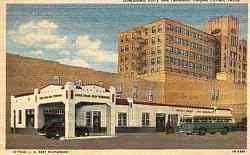
Lost opportunity

Corpus Christi bus station

This is the old Corpus Christi bus station, which I never saw. The current one is in a more utilitarian building. The
interior is dark, drab, and shabby. Around noon, I sat inside, with brief walks outside, for about 45 minutes. I watched four different Valley Transit buses arrive, with no one I knew coming off of them.

After numerous inquiries at the main desk, I learned that the only San Antonio bus had already arrived and that the San Antonio-Falfurrias bus did NOT stop in Corpus Christi. So I left, without the two Incarnate Word sisters I'd expected to meet.

In fact, earlier today I'd written an excited post, which has since been deleted, about Sister Rosa Margarita coming to visit me today. She called to tell me several nights ago that she would stop here for several hours on her way to Falfurrias to see her brother, so I think she and her friend were on the bus that did not stop here.

Sister Rosa Margarita is in charge of a weekly clinic for AIDS orphans/infants in Mongu, Zambia. When I went there with four other people from the Oblate School of Theology in June 2006 we visited on one of the days that the caretakers would bring the children. There were very few mothers left--only grandmothers, aunts, sometimes sisters. They give out powdered formula for a week to each child. However, the time we visited, they only had powdered milk, because they did not have the money to buy the formula. It is a wonderful program and is for VIC--for "vulnerable infants and children."

I am disappointed that we didn't connect, but hope Sr. Rosa Margarita has a good visit with her family in Falfurrias.
~~~~~~~~~~~~~~~~~
If you go to the link to the article in the San Antonio Express-News from Dec. 18, 2006, you'll find a spot to click on videos. If you do, there is one that features Sr. Rosa Margarita at the clinic we visited!

Friday, November 2, 2007

Zambia

http://www.wvi.org/wvi/africa_food_crisis/images/zambia.jpg I was so very surprised to visit The Mercy Blog and find a link to wonderful Geranium Farm, where Barbara Crafton has a remarkable sequence of poems based on the Beatitudes. These poems are beautiful and worthy to be read and re-read, but I also found her post about Zambia! As I mentioned in my post Plumpy'nut and Malnutrition in Africa, I was in Zambia for a month last year, so I am attracted to anything that is written about Zambia, especially in helping the people there.

Go to Barbara Crafton's meditation about Zambia Episcopal Relief and Development that has partnered with the Zambian Anglican Council and the M.A.C. AIDS Fund to create a pilot program aimed at helping pregnant women protect their unborn children from infection with HIV/AIDS through Preventing Mother To Child Transmission (PMTCT).

Sunday, October 21, 2007

Plumpy'nut and Malnutrition in Africa

Ever since I was in Zambia in June 2006, my heart has been aching for the starving and suffering children I saw there. Tonight I watched "60 Minutes" on CBS and found a news story about Doctors Without Borders feeding malnourished children plumpy'nut, which is either called "ready-to-use food" (RUF) or "ready to use therapeutic food" (RUTF). More scientific or "official" news articles use these acronyms for "plumpy'nut."

There is a news release from October 10, 2007 from Doctors Without Borders (MSF for its French initials) that cites the news program on CBS and gives much information about the use and effectiveness of plumpy'nut in Africa for malnutrition that is definitely worth your time and attention to look at.

"Project Peanut Butter was launched as a new approach to the treatment of malnutrition among Malawian children. The project has since been proven as an effective method with success rates reaching average recovery rates of 89.9% and even higher among some regions. The treatment centers on a peanut based paste rich in protein and fats with a complete complement of vitamins and minerals. This Ready-to-Use Therapeutic Food (RUTF) can be manufactured locally with importation of only the additional vitamins and minerals. The paste is resistant to bacterial contamination under all climatic conditions due to its low water content and does not require cooking. This is a tremendous advantage because it removes the burden of having to collect firewood and provides an easy way to produce nutritious food. "

Again from Doctors Without Borders:

"Severe acute malnutrition in early childhood is common in large areas of the Horn of Africa, the Sahel, and South Asia -- the world's "malnutrition hotspots." The World Health Organization (WHO) estimates that there are 20 million young children suffering from severe acute malnutrition at any given moment and MSF estimates that only three percent of them will receive RUF in 2007.


"Therapeutic RUF for only severely malnourished children, as current WHO, World Food Program, and UNICEF guidelines recommend, is too restrictive. Given its nutritional benefits, RUF has the potential to address malnutrition at earlier stages and is far more effective than fortified blended flour, which is normally distributed. MSF is piloting a program using a modified RUF as a supplement to prevent children from becoming acutely malnourished.


"Instead of waiting for kids to get gravely ill we decided to act earlier," said Dr. Susan Shepherd, MSF medical coordinator, Maradi, Niger. "We are piloting a program that gives RUF to all children under three in at-risk communities so that they get the nutrients that are missing in their normal diet."


This is hopeful, but something we all need to be supporting. So far away, I can continue to pray. But we can also participate in activities to alieve hunger like the CROP Walk and making donations to the organizations listed above and others that you research yourselves.

Remember:
The World Health Organization (WHO) estimates that there are 20 million young children suffering from severe acute malnutrition at any given moment and MSF estimates that only three percent of them will receive RUF in 2007.